Honours in Information Systems & Management
Information Systems & Management
Enquire now: 9480223900

why choose Information Systems & Management?
Learn to accurately estimate construction costs, manage project finances, and schedule construction activities effectively.
Gain expertise in GIS applications for spatial analysis and satellite imagery, useful for planning and managing construction projects
Develop comprehensive skills in Six Sigma methodologies, focusing on defining, measuring, analyzing, improving, and controlling processes.
Engage in hands-on projects that apply GIS mapping and Six Sigma tools to real-world scenarios in construction and project management
Platform and tools to learn - Project management software, GIS software like ArcGIS, and Six Sigma tools for quality control and process improvement.
Access to career resources - resume review, interview prep, career support on pathway completion
Accelerate your career with an Honors Degree
Online / 18 credits / Self-paced learning
Criteria
B.E / BTECH students in their 5th sem onwards who want to diversify their careers in the industry
Lectures from renowned subject matter experts from leading academia and industry across the world
Built in hands-on environment for practical implementation of the technologies covered with capstones.
Unlimited access to Coursera's catalog of 7,000+ world-class courses, hands-on projects, and job-ready
What will you learn from the program?
Total credits earned : 18 credits, 270 hours of learning
Gain hands-on experience in applying GIS mapping and Six Sigma tools to real-world scenarios in construction and project management.
Platform and tools to learn - capabilities and applications of rapid prototyping and 3D printing in product development.
Key Learnings: GIS applications for spatial analysis and satellite imagery, useful for planning and managing construction projects.
Immerse in project-based learning through Capstone projects
Access to career resources - resume review, interview prep, career support on pathway completion
Curriculum
This pathway integrates essential skills in construction management and quality control processes, blending practical knowledge in construction finance, cost estimating, and scheduling with advanced applications of Geographic Information Systems (GIS) and Six Sigma principles. Learners will explore the intricacies of managing construction projects from start to finish, understanding financial impacts, and optimizing project schedules. Additionally, the courses delve into GIS for spatial analysis and mapping, enhancing abilities in data handling and visualization. Six Sigma courses round out the training, providing a deep dive into process improvement, data analysis, and quality control strategies, preparing learners for roles that demand precision and efficiency in project execution and management.
Information Systems & Management
Construction Cost Estimating and Cost Control
- This course introduces the types of cost estimation from the conceptual design phase through the more detailed design phase of a construction project. In addition, the course highlights the importance of controlling costs and how to monitor project cash flow. Learners will work on a break-even analysis of construction tasks in a project. The course begins with Professor Odeh providing an overview of what will be covered. Next, learners explore the stages of design in a construction project. Professor Odeh then describes the types of cost estimates in a construction project, and the tools and methods used to create estimates.
Construction Finance
- This course expands the knowledge of a construction project manager to include an understanding of economics and the mathematics of money, an essential component of every construction project. Topics covered include the time value of money, the definition and calculation of the types of interest rates, and the importance of Cash Flow Diagrams. This module highlights around three case studies about PPP projects, which would be an introduction to project financing in horizontal work. After introducing case studies, the instructor demonstrates the risks associated with construction finance. After that, similar to the previous three courses, the course finishes with emphasizing the importance of construction finance.
Construction Project Management
- Construction Project Management introduces learners to Project Initiation and Planning. Columbia University professor, Ibrahim Odeh, along with industry experts join together to provide a comprehensive overview of the construction industry. There are 10 modules that allow learners to become knowledgeable of construction management within the dynamic construction industry. Professor Odeh teaches learners about the fundamentals of the Project Development Cycle while guest lecturers discuss Lean Project Delivery method and Lean Design Behaviors. Technological advances, such as Building Information Modeling (BIM), will be introduced with real world examples of the uses of BIM during the Lifecycle of the Project. The course concludes with Professor Odeh discussing the importance of project planning and scheduling and an opportunity to develop a Work Breakdown Structure.
Construction Scheduling
- This course focuses on learning how to develop and manage a schedule. The first module provides an overview of the Construction Scheduling course. The second module introduces bar or Gantt charts and how they are used as scheduling tools. During the third module, learners will create activity precedence diagrams, also referred to as activity on node diagrams, which graphically represent the construction activities in a project and their relationships. The fourth module provides an overview of the types of construction activity relationships encountered in a construction project and how to represent them in an activity precedence diagram. Forward and backward pass calculations are covered in the fifth module, and during the sixth module, Professor Odeh discusses the importance of critical paths, including what it is and why it is important.
Spatial Analysis and Satellite Imagery in a GIS
- In this course, you will learn how to analyze map data using different data types and methods to answer geographic questions. First, you will learn how to filter a data set using different types of queries to find just the data you need to answer a particular question. Then, we will discuss simple yet powerful analysis methods that use vector data to find spatial relationships within and between data sets. In this section, you will also learn about how to use ModelBuilder, a simple but powerful tool for building analysis flowcharts that can then also be run as models. You will then learn how to find, understand, and use remotely sensed data such as satellite imagery, as a rich source of GIS data. You will then learn how to analyze raster data. Finally, you will complete your own project where you get to try out the new skills and tools you have learned about in this course
GIS Data Acquisition and Map Design
- In this course, you will learn how to find GIS data for your own projects, and how to create a well-designed map that effectively communicates your message. The first section focuses on the basic building blocks of GIS data, so that you know what types of GIS files exist, and the implications of choosing one type over another. Next, we'll discuss metadata (which is information about a data set) so you know how to evaluate a data set before you decide to use it, as well as preparing data by merging and clipping files as needed. We'll then talk about how to take non-GIS data, such as a list of addresses, and convert it into "mappable" data using geocoding. Finally, you'll learn about how to take data that you have found and design a map using cartographic principles. In the course project, you will find your own data and create your own quantitative map.
GIS, Mapping, and Spatial Analysis Capstone
- In this capstone course, you will apply everything you have learned by designing and then completing your own GIS project. You will plan out your project by writing a brief proposal that explains what you plan to do and why. You will then find data for a topic and location of your choice, and perform analysis and create maps that allow you to try out different tools and data sets. The results of your work will be assembled into an Esri story map, which is a web site with maps, images, text, and video. The goal is for you to have a finished product that you can share, and that demonstrates what you have learned.
Introduction to GIS Mapping
- Get started learning about the fascinating and useful world of geographic information systems (GIS)! In this first course of the specialization GIS, Mapping, and Spatial Analysis, you'll learn about what a GIS is, how to get started with the software yourself, how things we find in the real world can be represented on a map, how we record locations using coordinates, and how we can make a two-dimensional map from a three-dimensional Earth. In the course project, you will create your own GIS data by tracing geographic features from a satellite image for a location and theme of your choice. This course will give you a strong foundation in mapping and GIS that will give you the understanding you need to start working with GIS, and to succeed in the other courses in this specialization.
Six Sigma Advanced Analyze Phase
- This course is for you if you are looking to dive deeper into Six Sigma or strengthen and expand your knowledge of the basic components of green belt level of Six Sigma and Lean. Six Sigma skills are widely sought by employers both nationally and internationally. These skills have been proven to help improve business processes and performance. This course will take you deeper into the principles and tools associated with the "Analyze" phase of the DMAIC structure of Six Sigma.
Six Sigma Advanced Define and Measure Phases
- In this course, your instructors will introduce you to, and have you apply, some of the tools and metrics that are critical components of Six Sigma. This course will provide you with the advanced knowledge of team dynamics and performance, process analysis, probability, statistics, statistical distributions, collecting and summarizing data, measurement systems analysis, process and performance capability, and exploratory data analysis associated with Six Sigma and Lean.
Six Sigma Advanced Improve and Control Phases
- This course is for you if you are looking to dive deeper into Six Sigma or strengthen and expand your knowledge of the basic components of green belt level of Six Sigma and Lean. Six Sigma skills are widely sought by employers both nationally and internationally. These skills have been proven to help improve business processes and performance. This course will take you deeper into the principles and tools associated with the "Improve" and "Control" phases of the DMAIC structure of Six Sigma.
Six Sigma and the Organization (Advanced)
- This course is for you if you are looking to dive deeper into Six Sigma or strengthen and expand your knowledge of the basic components of green belt level of Six Sigma and Lean. Six Sigma skills are widely sought by employers both nationally and internationally. These skills have been proven to help improve business processes and performance. This course will introduce you to the purpose of Six Sigma and its value to an organization. You will learn about the basic principles of Six Sigma and Lean. Your instructors will introduce you to, and have you apply, some of the tools and metrics that are critical components of Six Sigma. This course will provide you with the basic knowledge of the principles, roles, and responsibilities of Six Sigma and Lean.
Six Sigma Principles
- This course is for you if you are looking to learn more about Six Sigma or refresh your knowledge of the basic components of Six Sigma and Lean. Six Sigma skills are widely sought by employers both nationally and internationally. These skills have been proven to help improve business processes and performance. This course will introduce you to the purpose of Six Sigma and its value to an organization. You will learn about the basic principles of Six Sigma and Lean. Your instructors will introduce you to, and have you apply, some of the tools and metrics that are critical components of Six Sigma. This course will provide you with the basic knowledge of the principles, roles, and responsibilities of Six Sigma and Lean.
Six Sigma Tools for Analyze
- This course will cover the Measure phase and portions of the Analyze phase of the Six Sigma DMAIC (Define, Measure, Analyze, Improve, and Control) process. You will learn about lean tools for process analysis, failure mode and effects analysis (FMEA), measurement system analysis (MSA) and gauge repeatability and reproducibility (GR&R), and you will be introduced to basic statistics. This course will outline useful measure and analysis phase tools and will give you an overview of statistics as they are related to the Six Sigma process.
Six Sigma Tools for Define and Measure
- This course is for you if you are looking to learn more about Six Sigma or refresh your knowledge of the basic components of Six Sigma and Lean. Six Sigma skills are widely sought by employers both nationally and internationally. These skills have been proven to help improve business processes and performance. This course will cover the Define phase and introduce you to the Measure phase of the DMAIC (Define, Measure, Analyze, Improve, and Control) process. You will learn about Six Sigma project development and implementation, you will become familiar with project management tools, you will be introduced to statistics and understand its significance to Six Sigma, and finally you will learn about data collection and its importance to an organization.
Six Sigma Tools for Improve and Control
- This course will provide you will the tools necessary to complete the final components of the analyze phase as well as the improve and control phases of the Six Sigma DMAIC (Define, Measure, Analyze, Improve, and Control) process. This course is the final course in the Six Sigma Yellow Belt Specialization. You will learn about relationships from data using correlation and regression as well as the different hypothesis terms in hypothesis testing. This course will provide you with tools and techniques for improvement. You will also understand the importance of a control plan, as well as its key characteristics, for maintaining process improvements. Every module will include readings, discussions, lecture videos, and quizzes to help make sure you understand the material and concepts that are studied.
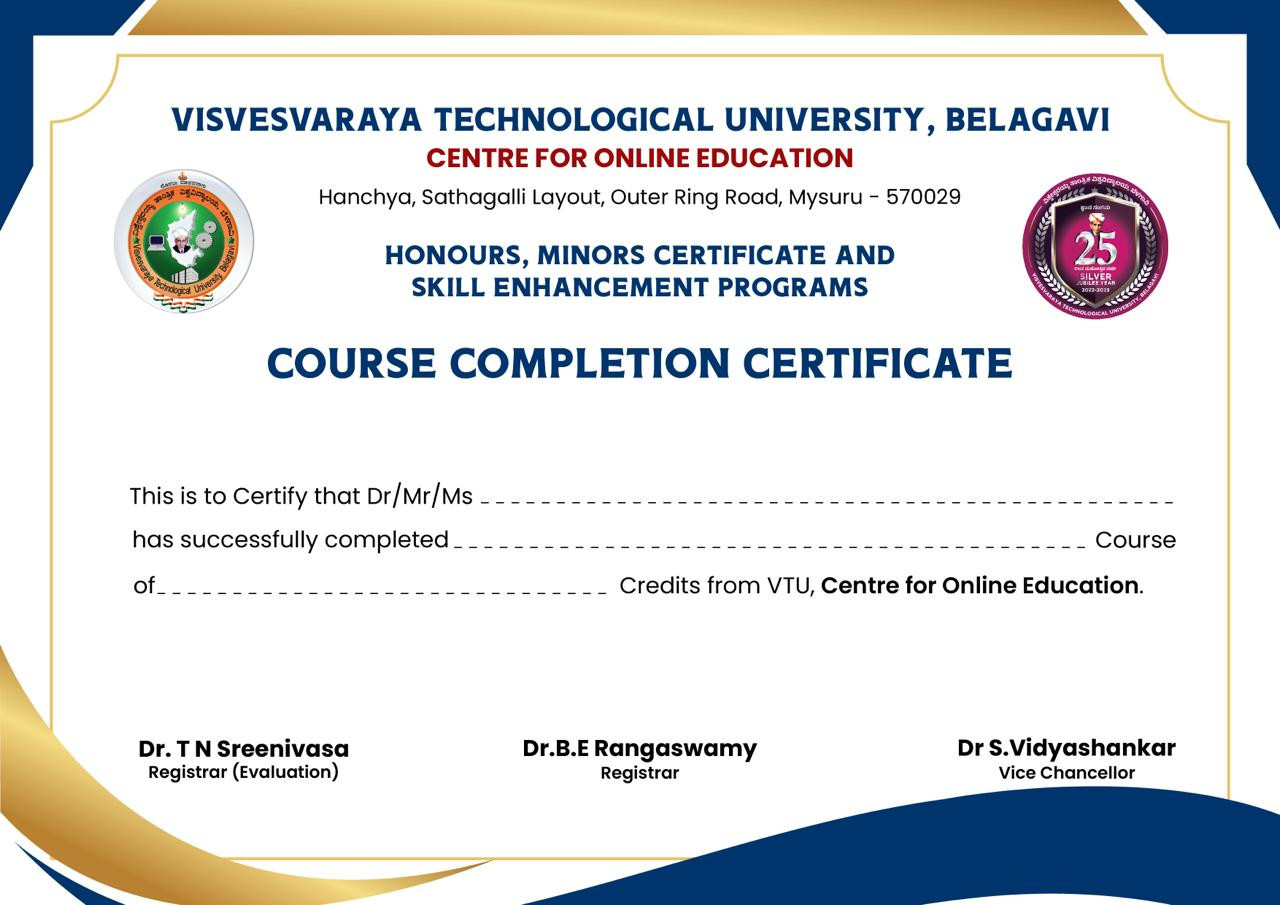
Honours Degree from VTU University
|
||
Program Fee
Paid |

|
|
Application Process
Register to Honour/Minor degree by filling online application and by paying registration fee.
Get your online application approved.
Start enrolling to Honour/Minor degree program.
Admissons are closed once the requisite number of participants enroll for the upcoming cohort. Apply early to secure your seat.
Deadline:30-May-2024
Frequently Asked Questions
What Is a Honors Degree?
The Honors degree programme is designed to empower graduate engineering students with industry and career readiness through skill-based learning and application tools.
How will this programme help students in building their proficiency?
Prerequisites is to be a student of BE/B.Tech with basic knowledge in computer science, information technology, or a related field.
How is this programme different from other industry programmes?
This programme is designed by globally renowned industry and university content partners to combine academic concepts with emerging industry skills and technologies for the students entering
What will students get once they enroll and complete this Honors pathway?
For AWS Cloud Quest: Cloud Practitioner, once you finish a solution building activity, you are not able to go back and finish the practice lab section.
Contact
Still have queries?
Contact Us
Please fill in the form and a Program Advisor will reach out to you. You can also reach out to us at onlineprograms@vtu.ac.in or 9480223900